Once it moves, don't stop
You're the pourer at Haskell's, a two-furnace jobbing foundry. They cast sash weights, gate hinges and firebacks for whoever walks in. Dot Haskell, the foreman, chalks a pattern card for every mould. You hold the ladle.
Drag up and the ladle tips. Drag down and it eases back. Let go and it rights itself. That's every control in the pour.
The catch is the clock you can't see. The metal starts cooling the moment it leaves the ladle. If you set the ladle upright for more than about half a second once the pour has started, the pour is over. Dot calls that a cold shut. Whatever isn't full stays empty.
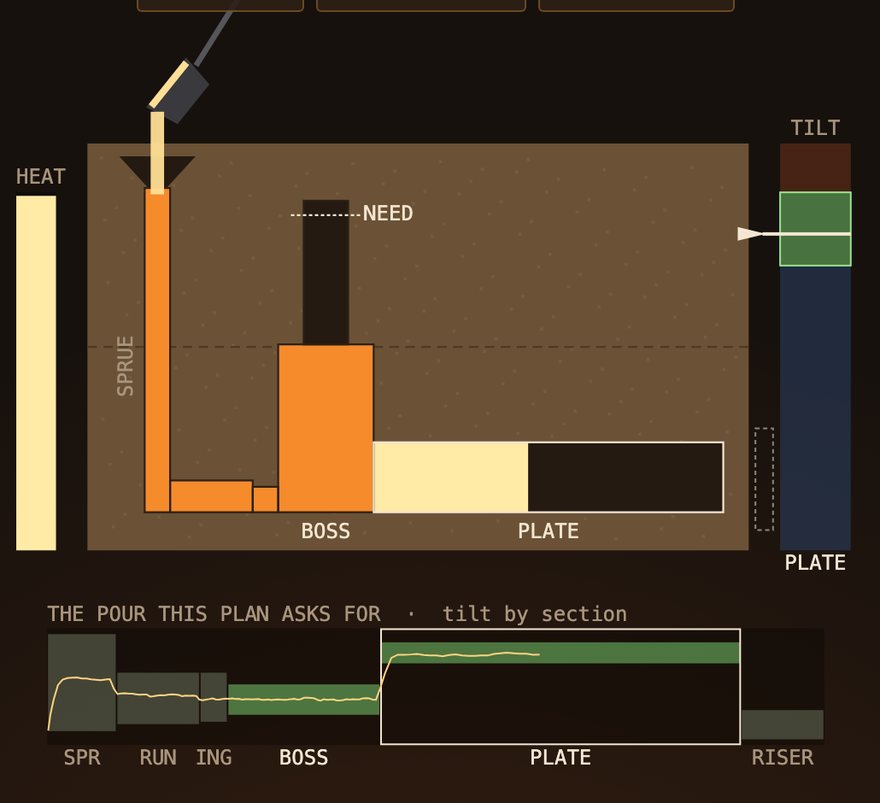
Too slow, it freezes. Too fast, it tears the sand.
Each part of the mould prints a green band on the tilt gauge at the right edge. Stay inside it.
- Under the band, the front chills. The HEAT bar on the left drains. When it's empty the front freezes, and everything past that point never fills. That's a misrun.
- Over the band, the metal scours the sand out of the mould wall. That part comes out pitted. That's sand wash.
Thin parts want it fast, because they chill fast. Heavy parts want it gentle. The strip under the mould shows the band for every part in order, so you can see the next change coming.
Ease right off at the riser
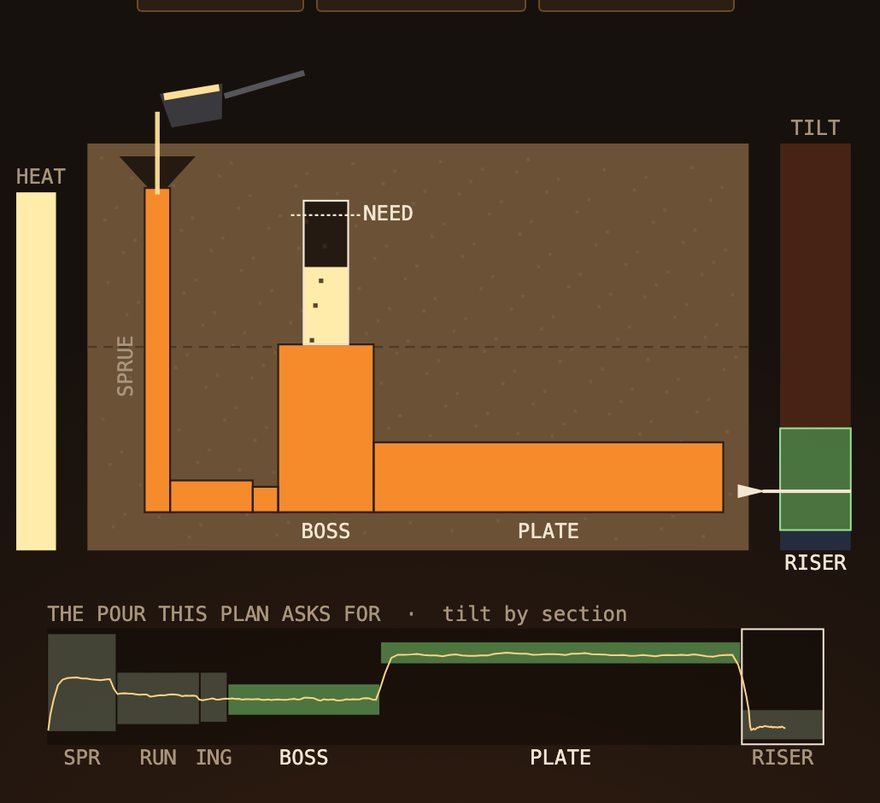
The last box in every mould is the riser. As the casting cools it shrinks, and the riser is the spare metal that feeds the heaviest part while it does.
Fill it past the NEED line, which is 90% full. Stop before the brim, or the extra goes on the floor. And fill it slowly. Fast metal froths in the riser and won't feed. Short of NEED or too fast, it shows up on the casting as shrink, a hole in the heavy part. Over the brim, it costs you as spill.
So the pour that works is almost never one speed. Usually it changes for every part, then goes deliberately slow the moment the riser starts. Then you let go.
Pick the gating before you pick up the ladle
From the second mould on, Dot gives you three ways to bring the metal into the cavity. You choose before the pour, with all the time you want.
- WIDE RUNNER. The runner's ceiling goes way up, but every cavity floor rises: the metal arrives colder.
- BOTTOM GATE. Deep parts fill calm from below. Thin floors rise, because it's a long, cold climb.
- TOP GATE. Hot and short. Every floor drops, but metal falls into the deep parts, and their ceilings drop hard.
Tap a plan and the bands redraw. When a plan leaves a part with no green band at all, it gets a red cross and the card tells you.
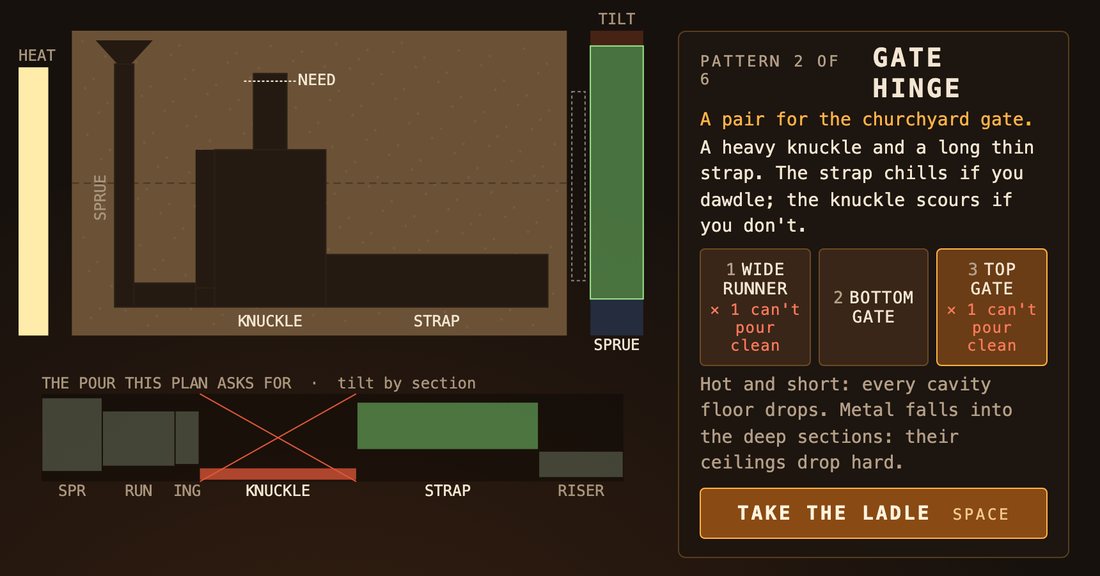
No plan is the right one everywhere. Across the five moulds with a choice, Dot's best plan is BOTTOM GATE twice, WIDE RUNNER twice and TOP GATE once.
Then the sand comes off
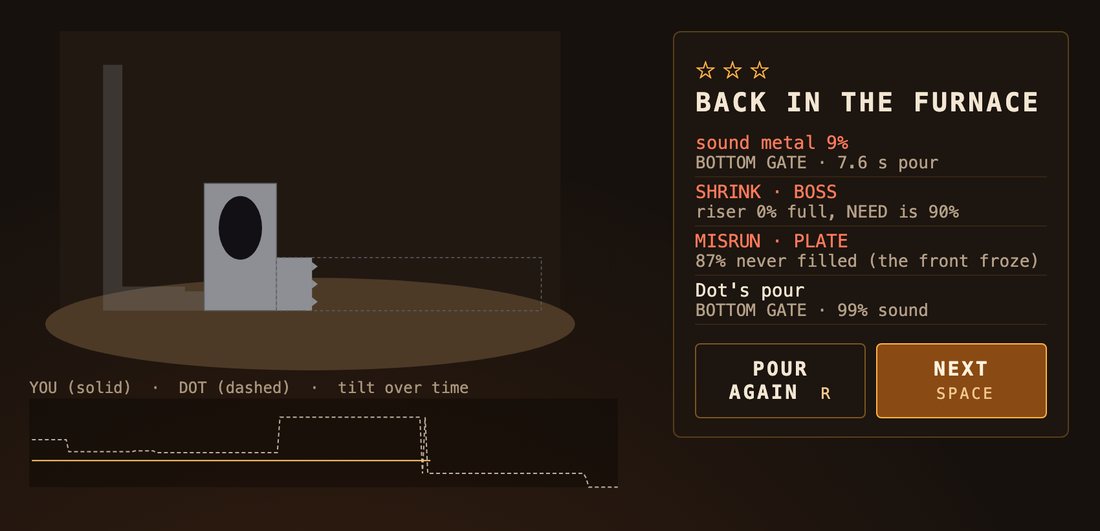
The mould breaks open and you see the casting you made. Every defect is drawn where it is, with a row that says what happened. Under it is a chart of your tilt over time, with Dot's pour dashed behind it.
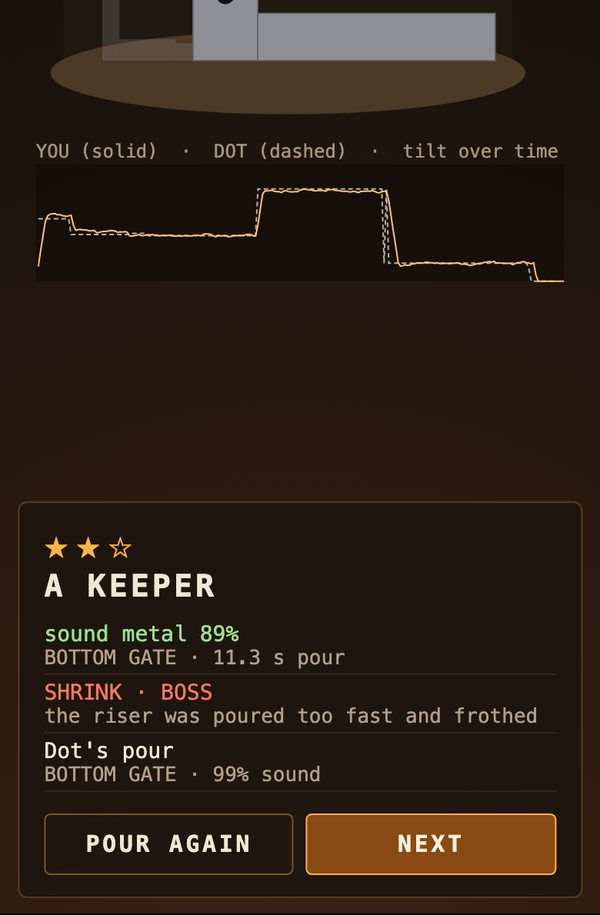
A scripted test hand poured this one, and it's a keeper. The solid line sits right on Dot's for the whole pour. One row is red: the riser went in a little fast and frothed, so the boss shrank. That's two stars, not three.
Stars count sound metal, the share of the casting with no misrun, wash or shrink in it, less anything spilled. 90% is three stars. 75% is a keeper and it ships. Under that it's scrap, and it goes back in the furnace.
Nothing is lost when it does. That's what the sprue is for: the spare iron goes back in the pot. You can pour a mould again as soon as it comes out of the sand, as often as you like, and the shift report keeps your best.
Six moulds, two shifts
| Mould | For | What it asks |
|---|---|---|
| 1 · SASH WEIGHT | Twelve for the joiner on Cooper Street. | One fat bar. Dot picks the gating. It's where you learn. |
| 2 · GATE HINGE | A pair for the churchyard gate. | A heavy knuckle, then a long thin strap. |
| 3 · PULLEY WHEEL | For the hay hoist at Pender's barn. | Hub, then the thinnest metal of the day in the spokes, then a long rim. |
| 4 · BOOT SCRAPER | Six for the chapel steps. | Thin blade, squat foot, thin blade. Fast, slow, fast, then the riser. |
| 5 · FIREBACK | For the Talbots' new hearth. Their name goes on it. | The longest run of thin metal in the shop. |
| 6 · SHIP'S CLEAT | Bronze would be nicer. The harbourmaster says iron. | Base, horn, waist, horn: slow, fast, middling, fast. |
The "For" lines are Dot's, straight off the pattern cards. A pour takes 10 to 20 seconds or so. A whole mould, card to shakeout, takes about a minute.
Straight answers
- What does it cost?
- Nothing. No ads, no account, no install. It runs in the browser, on this page or full screen.
- Phone or computer?
- Either. On a phone you drag with your thumb, anywhere on the game. On a computer you drag with the mouse, or hold ↑ and ↓. Two things to know on a phone. The pattern card often hides its TAKE THE LADLE button below the fold, so swipe the card up to find it. And phones can't pause yet: the tea break is on ESC.
- Is it realistic?
- The words are a foundry's: sprue, runner, ingate, riser, misrun, cold shut, shakeout. The physics is a diagram. Each part of the mould is a box with a speed band, and heat is one bar. If you pour real iron, you'll know where it's simplified. You may still recognize the riser.
- Is it hard?
- The first mould gives three stars to any steady, middling tilt, on purpose. Too timid or too eager still fails it. On the middle three, a steady tilt eased off at the riser can still make three stars, but only in a narrow band of tilt, and on the BOOT SCRAPER only on a plan the card marks with red crosses. The FIREBACK and the SHIP'S CLEAT are different. In test runs on the game's own engine, a steady tilt eased off at the riser never made three stars on either one, on any gating. Those two want the pour to change speed part by part.
- How long is it?
- Six moulds at a minute or so each. Both shifts take well under a quarter of an hour. Longer if you pour one again for three stars.
- Who's played it?
- Honestly, nobody yet. Every pour on this page, the pictures too, came from scripted hands on the game's own engine. They read each band, with lag and wobble built in to act like a thumb. You'd be one of the first people to pour it.
Take the ladle.
Dot's chalked the first card. It's a sash weight. It wants about eleven seconds of your thumb.